
Common names
Necklace Carpetshark, Varied Carpetshark, Varied Catshark.
Binomial
Parascyllium variolatum.
Synonyms
Hemiscyllium variolatum, Parascyllium nuchalis.
Identification
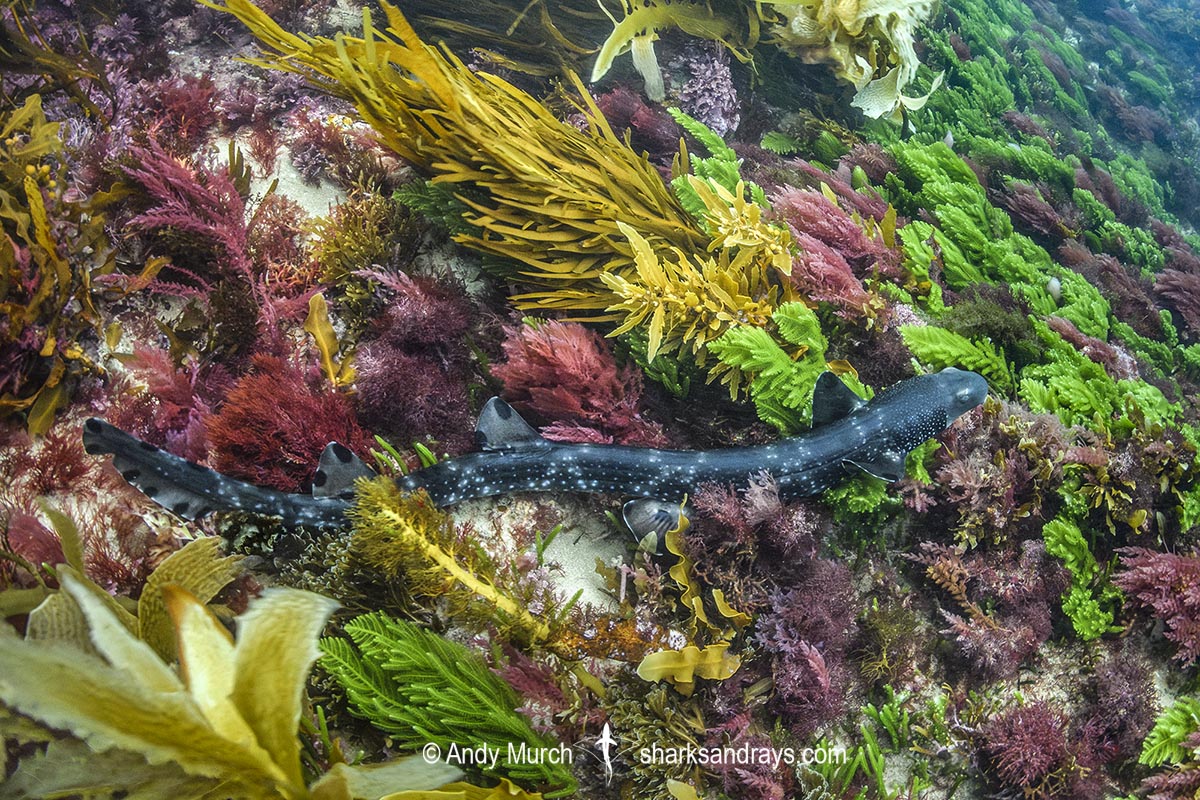
Extremely slender, elongated, eel-like body. Head relatively small. snout short and dorsally compressed. Eyes large and slightly protruding. Nasal openings oval. Barbels small. Well developed pectoral and pelvic fins with mildly convex posterior margins. Two equally sized dorsal fins on rear-body. Origin of first dosal half way between pectoral fin and caudal fin. Origin of second dorsal half way between first dorsal and caudal fin. Pelvic fins relatively far forward; origin well forward of first dorsal fin. Anal fin insertion level with second dorsal fin origin. Caudal fin long, with a strong sub-terminal notch. Caudal lobes mildly convex.
Dorsal coloration extremely striking. Base colour usually bluish-grey (sometimes light brownish-grey) with dark or black saddles and many very small white spots. A broad dark/black ring with small while spots encircles the ‘neck’ between eyes and pectoral fins; hence common name. Larger than eye-sized black spots on all fins.
Size
Maximum length 91cm.
Conservation Status
LEAST CONCERN
The Varied Carpetshark (Parascyllium variolatum) is a wide ranging species throughout much of temperate Australia, although it may eventually be split into multiple regional species. It is not targeted and is usually a discarded bycatch.
Habitat
Found over a wide range of substrates from rocky reefs to sand, kelp, and sea grass. From the intertidal zone to 180m.
Distribution
Endemic to Southern Australia, from Southern WA to Victoria, including northern Tasmania.
Reproduction
Oviparous. Egg capsules have long springy tendrils at one end that anchor the egg case to the substrate.
Diet
Unknown. Probably benthic invertebrates.
Behavior
Mostly nocturnal. Hides by day in recesses or in the undergrowth. Swims over open ground or wriggles through kelp in search of prey.
Reaction to divers
Quite remains motionless, relying on camouflage when discovered among seaweeds.
Diving logistics
The necklace carpetshark in present at many inshore dive sites throughout southern Australia, but appears to less commonly encountered than previously.
One sheltered spot with consistent sightings is Lonsdale Beach within Port Phillip Bay, south of Melbourne. It also shows up at sites in souther WA, but western sightings may represent an undescribed species.
What’s new
View our full list of updates
Similar species
Rusty Carpetshark (Parascyllium ferrugineum) Distinguished by overall brown-grey brown body with small black spots.
Collared Carpetshark (Parascyllium collare) Distinguished by overall brown-grey brown body with black spots and dusky or no saddles.
